This category allow users to create, manipulate, and process JSON data efficiently in automation workflows. These activities streamline the integration of JSON-based data with other automation components, improving efficiency in data processing.
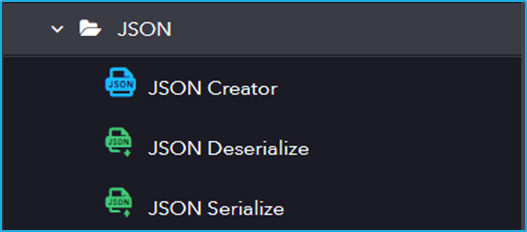
The JSON category has the following sub activities:
JSON Creator: This activity returns a JObject that encodes a string object. It accepts a string in JSON format and can map variables or values to the respective nodes in the string.
InputProperties:
Options: Creates a string in JSON format. It allows you to map or assign values to the corresponding nodes in the string.
Output Properties:
JSONObject: The resulting JSON object that is stored in an object variable.
JSON Deserialize: This activity accepts a string in JSON format and converts it into a JSON Object.
InputProperties:
JSONString: The JSON string that you want to convert into an object.
Output Properties:
JSONObject: The resultant JSON object is stored in an Object variable.
JSON Serialize: This activity converts an input Object into a string in JSON format.
InputProperties:
Object: The JSON Object that you want to serialize.
Dictionary includes activities for working with key-value pairs, allowing efficient storage, retrieval, and manipulation of data where each value is associated with a unique key.
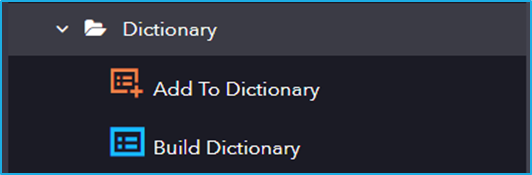
The Dictionary category has the following sub activities:
Add To Dictionary: This activity is used to add key-value pairs to a dictionary.
Input Properties:
Dictionary– Specify the dictionary variable to which the key-value pairs will be added.
Key– Specify the key to be added to the dictionary.
Value– Specify the value to be associated with the given key in the dictionary.
IsOverwrite– Select this check box to overwrite the value if the key already exists in the dictionary.
Build Dictionary: This activity is used to create a new dictionary for storing keys and values.
Input Properties:
Build– Add the desired number of keys and their corresponding values to the dictionary.
Output Properties:
Dictionary– Stores the added key-value pairs in the dictionary variable.
DateTime includes activities for manipulating and formatting date and time values, allowing you to perform operations such as calculating time differences, adding/subtracting dates, and formatting date/time outputs.
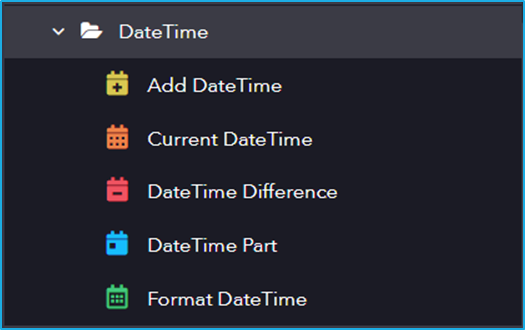
The DateTime category has the following sub activities:
Add DateTime: This activity allows the user to add a Date and Time by giving an interval specified by the user in the properties section.
Input Properties:
Interval– The time/date interval to add.
DateTime– Date time to which number is to be added.
Number– The number of intervals to add to the date. Positive values give future dates, while negative values give past dates.
Output Properties:
Added DateTime– The variable that stores the added DateTime value.
Current DateTime: This activity gets the Current Date Time of a Specified TimeZone.
Input Properties:
TimeZone– Select the standard time zone.
Output Properties:
Current DateTime– The variable that stores the standard time for the selected time zone.
DateTime Difference: This activity can be used to find the difference between the specified Start and End datetime.
Input Properties:
Interval– Select the interval to calculate the DateTime difference. Or Select the part to return for the DateTime difference (e.g., year, month, day).
StartDate – Specify the starting DateTime for the difference calculation.
EndDate– Specify the ending DateTime for the difference calculation.
Output Properties:
Date Difference– The variable that stores the calculated difference between two DateTime values.
DateTime Part: This activity is used to get a part of the date.
Input Properties:
Interval– Select the specific part of the DateTime argument to return (e.g., year, month, day).
DateTime– The DateTime from which the specified part is to be extracted.
Output Properties:
DatePart– The variable that stores the integer value of the DateTime part.
Format DateTime: This activity converts a specific date-time into any format of the user’s choice in the form of an output string variable.
Input Properties:
Value– Enter the DateTime value to be formatted.
Format– Select the desired DateTime format.
Output Properties:
Formatted DateTime– The variable that stores the formatted DateTime.
Collection includes activities for managing and manipulating data structures such as lists, dictionaries, and arrays to store and process multiple values efficiently.
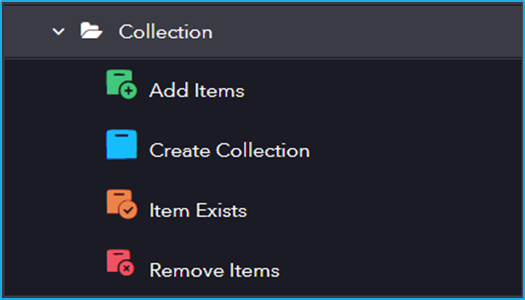
The Collection activity has the following sub activities:
Add Items: This activity is used to add an array of items to a specified collection.
Input Properties:
Collection– The variable that holds the collection items. Or Variable storing collection items.
Items– Array of items added to the collection. Or Array of items in the collection.
Create Collection: This activity is used to create a new collection of an ArrayList data type.
Output Properties:
Collection– The variable that holds the collection items. Or Variable storing collection items.
Item Exists: This activity is used to check if the specified item exists in the collection or not.
Input Properties:
Collection– The variable that holds the collection items. Or Variable storing collection items.
Items– Array of items to check in the collection.
Output Properties:
Exists– Boolean variables which indicate whether the array of items exists or not.
Remove Items: This activity is used to delete an array of items from a collection.
Input Properties:
Collection– The variable that holds the collection items.
Items– Array of items to remove from the collection.