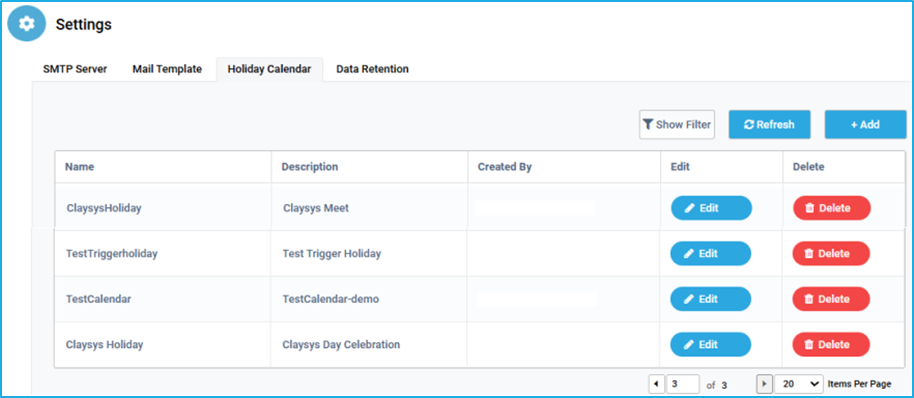
In the Holiday Calendar tab, the user has the option to create a custom calendar where a specific holiday can be added. The holiday calendar comes into the role when there is a need to exclude trigger execution on a particular day. Using the Holiday Calendar feature, the user has the option not to execute a trigger on selected days. The required calendar can be selected while creating a trigger so that the trigger does not execute on the holidays mentioned in the calendar.
Add Calendar
Steps to create a calendar in the Bot Manager:
Click on ‘+Add’ button.
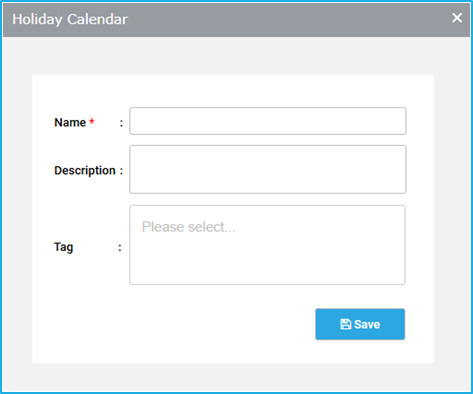
Provide a valid calendar name and description in the popup window that will appear.
In the Tags field, enter a relevant tag name for easy filtering in Bot Manager. (Optional) and Click on ‘Save’.
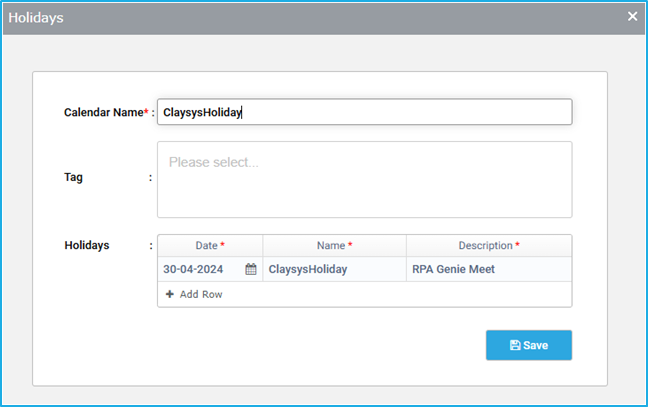
Next, to add the date to the calendar, click ‘Details’ against the newly created calendar name.
Customize the date and other details in the popup window that will appear and Click on ‘Save’.
Note: For adding/removing a holiday from the calendar, use the ‘+/-‘ option by hovering over it.
In case a specific holiday calendar is no longer needed, it can be deleted by clicking on the delete button. On clicking the ‘delete’ button for a specific Holiday Calendar, a validation box with a warning will appear allowing the user to either confirm the deletion by selecting the “OK” option or to cancel it.
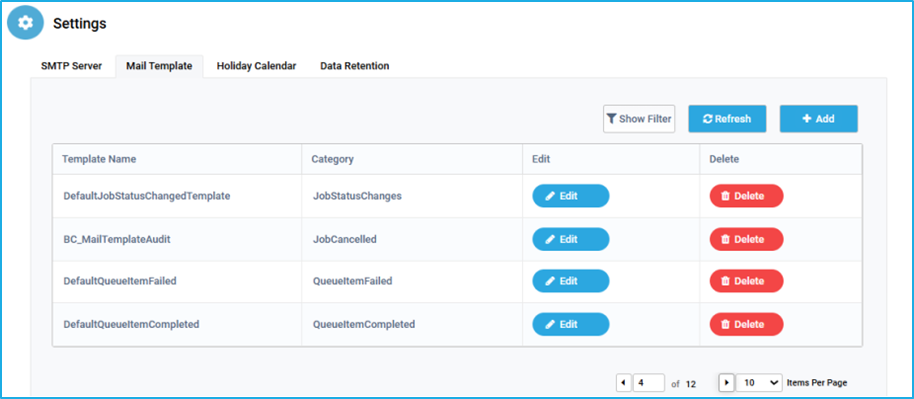
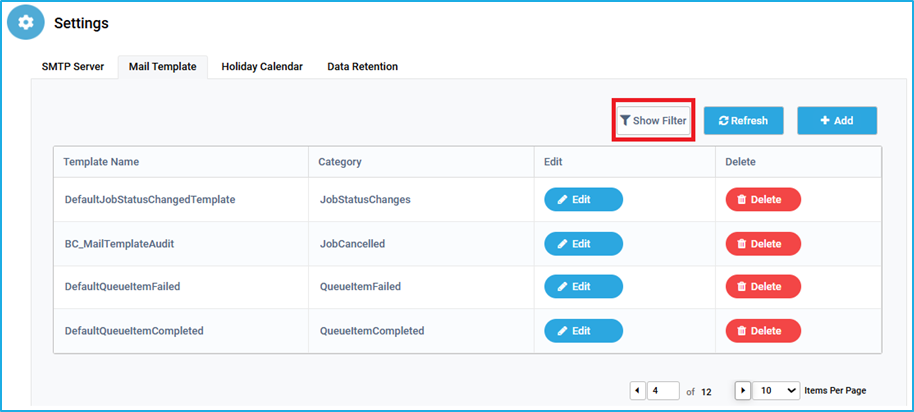
In the Mail Template tab, users will be able to see all default templates of the mail notification alerts for each event that takes place pertaining to robots, machines, jobs, queues and triggers. Apart from the default template, the user has the option to create a custom template by clicking on the ADD button. This tab displays the TemplateName and Category for the created templates. The user has to click on the ‘Edit’ button next to the respective template name if the user wants to alter the Template name, Category, subject and body of the email. Also, the relevant tags can be added and the ‘Isdefault’ toggle button can be used to set the template as default. The ‘Delete’ option is also available if a specific template is no longer needed.
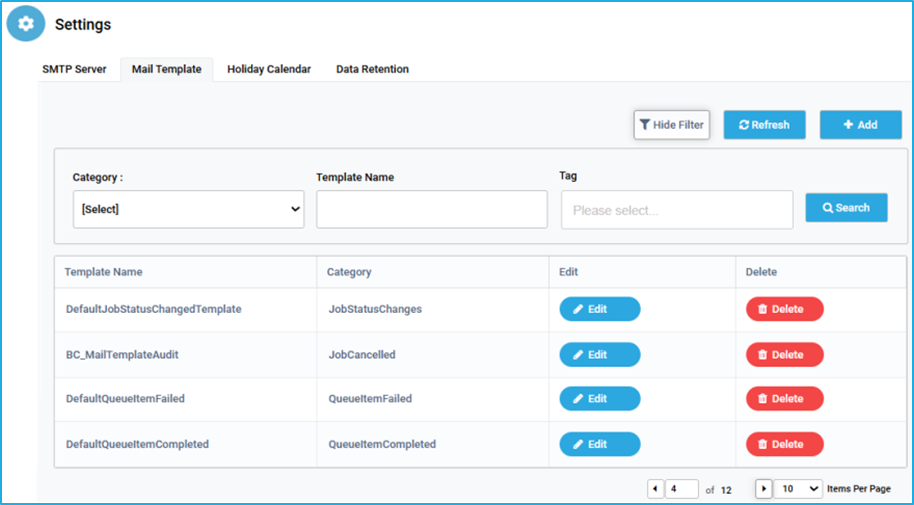
The “Show Filter” button helps to filter the mail templates based on the Category, Template Name and Tags.
The “Search” button can be clicked after entering the required data in the respective field(s).
The “Refresh” button helps to reload the window so that user can view the latest details.
Adding a new Mail Template
Apart from the default template, the user has the option to create a custom mail template.
Steps to create a Mail Template in the Bot Manager:
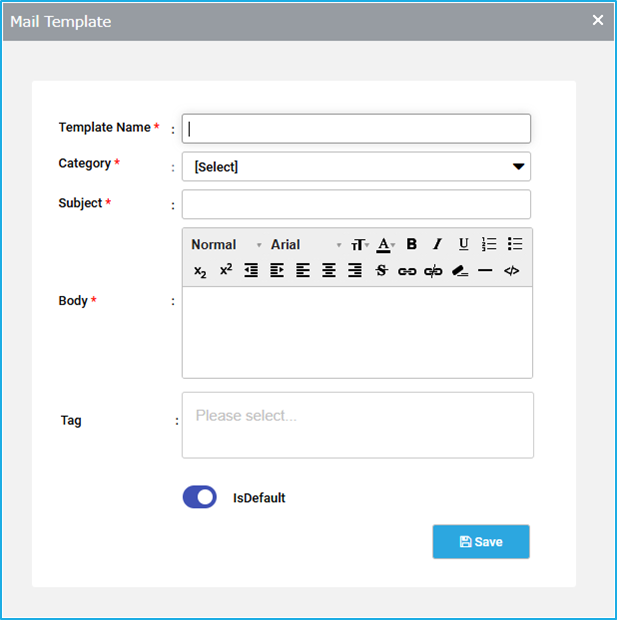
Click on the ‘+Add’ button to create a new mail template.
In a new window that will appear, provide input to the mandatory fields such as Template name, Category, Subject and Body that need to be filled out depending on the alert type.
If the “IsDefault” toggle button is enabled, then the default mail template would be the custom template created by the user.
There is also a section to add any existing tags to simplify the filtering of mail templates.
Editing/Deleting an Existing Template
The user has to click on the ‘Edit’ button next to the respective template name if the user wants to alter the Template name, Category, subject, body of the email, and Tags. Users can also set this template as a default by enabling the ‘IsDefault’ toggle button. The delete option is also available if a specific template is no longer needed.
Customizing the Mail template
While customizing the Mail template user can give a meaningful template name and a subject line. The user can customize the subject line of the notification mail by using the BOT manager notification template. When it comes to the body of the mail, user needs to follow the below given formats in order to fetch the ROBOT, QUEUE, MACHINE and JOB details.
The format for creating the body is @Model.[Model Variable].
Category indicates the specific alert type for which the notification mail has to be sent.
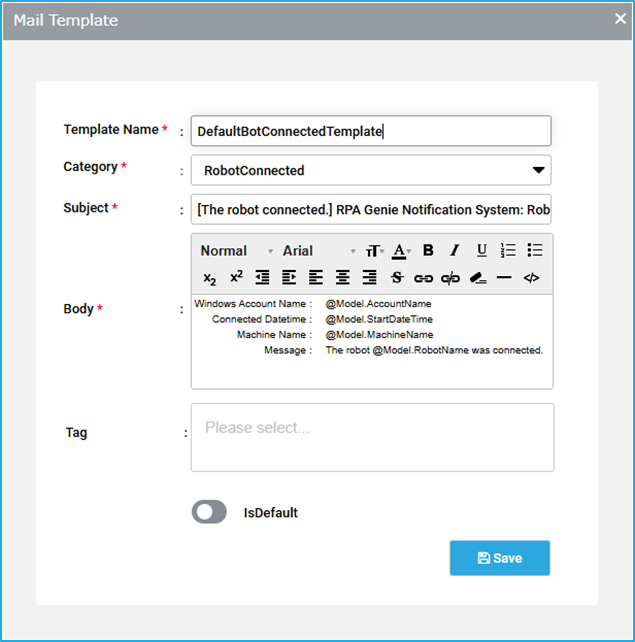
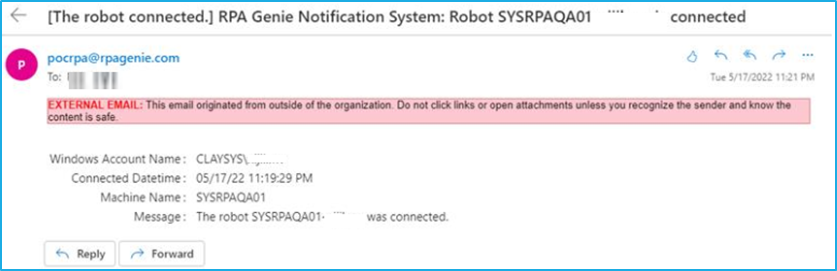
Example: The body template for the category of ROBOTConnected.
Windows Account Name: @Model.AccountName
Connected Date&Time: @Model.StartDateTime
Machine Name: @Model.MachineName
Message: The Robot @Model.RobotName was connected.
Screenshot of rendered mail body
Bot Manager Notification Template
Refer to the below provided tables for the available categories and Model variable name which can be used in mail templates:
Machine
Categories: MachineConnected, MachineDisconnected
Model Variable
Description
Machinename
The Name of the Machine
StartDateTime
Agent Service start Date and Time.
EndDateTime
Agent Service end Date and Time.
Robot
Categories: RobotConnected, RobotDisconnected
Model Variables
Description
AccountName
Account Name of robot session.
StartDateTime
The robot session’s start date and time.
EndDateTime
The robot session’s end date and time, only if Robot is disconnected.
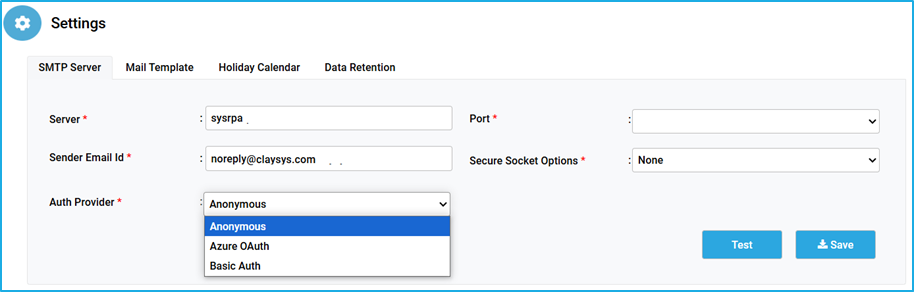
The SMTP server setting can be configured to enable email alerts where users will be able to receive notifications whenever a specific event takes place.
Steps to configure the SMTP Server:
Provide the proper SMTP server machine name.
Provide the appropriate port number as the communication of SMTP takes place using this port number.
Provide the email through which the mail will be sent in the SMTP SenderEmailID field
If the SMTP uses secure socket options, then select the appropriate one from the drop-down list; otherwise, set it to None in the SMTP secure socket options field.
Select the appropriate option (Anonymous, Azure OAuth, Basic Auth) from the drop-down list in the ‘Auth Provider’ field.
Note: If Basic Auth is selected, the user must enter a username and password. If Azure OAuth is selected, the user must provide the Tenant ID, Client ID, and Client Secret.
There is also an option to test the server details by clicking on the ‘Test’ button and the user will receive a test email if SMTP server details are correct.
Once the settings are saved successfully, a user starts receiving email alerts whenever an event occurs.
BMT Settings allows users to modify the default settings as per their preferences pertaining to the configuration of mail settings, customization of mail templates/holiday calendars, and retention of data for the specified duration. This functionality is split into four separate tabs under the BMT settings in the Bot Manager:
SMTP server: Enables email alerts requiring users to configure server details and test the setup.
Mail Template: Allows users to use default mail templates or add/edit customized templates for various events.
Holiday Calendar: Allows users to add/edit holiday calendars to ensure triggers do not execute on specified holidays.
Data Retention: Allows users to manage the retention period of logs to free up database space.
Clicking on the “Add” button in the resources tab.
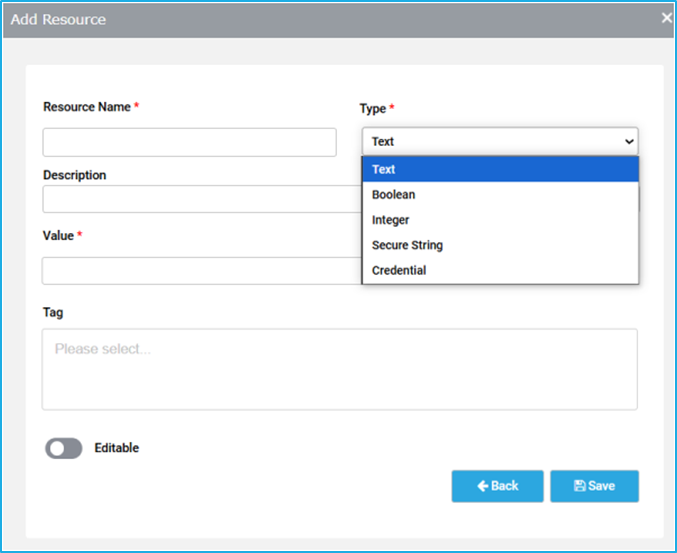
An ‘Add Resource’ window will appear where the following details need to be specified:
Resource Name: Provide an appropriate name to the resource. It can be any combination of characters, digits, or underscores. However, the name should not begin with a number and there shouldn’t be any spaces between the characters.
Type: Select the resource value’s type from the type dropdown. Five different types of resource values can be selected:
Text – store strings in text format.
Boolean – stores true or false values
Integer – exclusively stores whole numbers.
Secure String- save data of string type which will be stored in an encrypted format.
Credential – store sensitive data such as username and password.
Description: Provide a description of the resource in this field. However, it is an optional field.
Value: Provide the resource value in accordance with the type of the resource.
Tags: Enter a relevant tag name for easy filtering in Bot Manager. (Optional)
Editable: If the ‘editable’ toggle button is enabled then, the user can update this resource using the activities available in the RPA Genie Studio.
The Resource tab in the bot manager enables users to create, store and maintain certain data in the form of shared variables of various data types such as Text, Boolean, Integer, Secure String and credential. These resources can be accessed through RPA Genie Studio and can be used in various automation projects. This feature acts as an asset management tool.
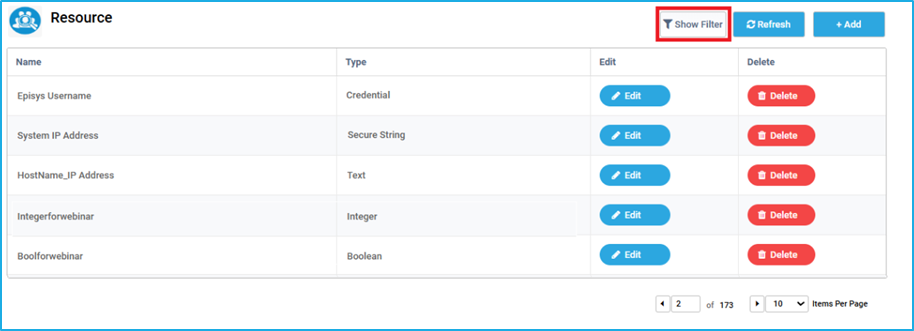
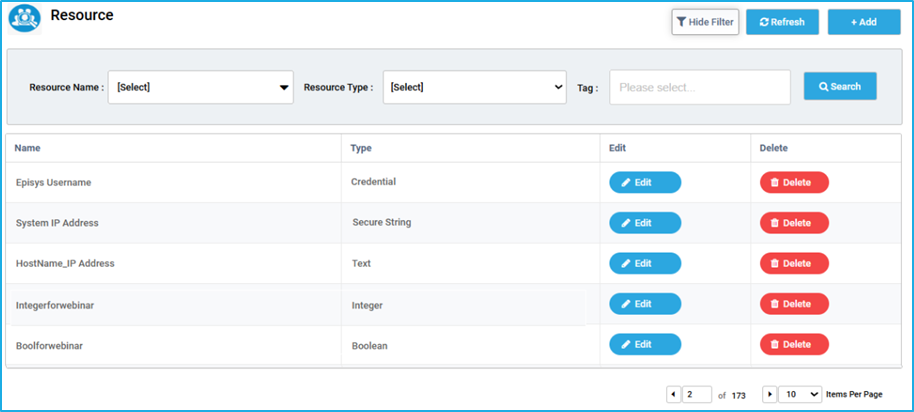
In the Resources tab, there is a table that displays the name and the type of the Resource that is created. On clicking the ‘Edit’ button for a particular resource, the ‘Edit Resource’ wizard will appear, where the user can amend the details of the resource. On clicking the ‘delete’ button for a certain resource, a validation box with a warning will appear allowing the user to either confirm the deletion by selecting the “OK” option or to cancel it. The “Add” button allows to create a new resource.
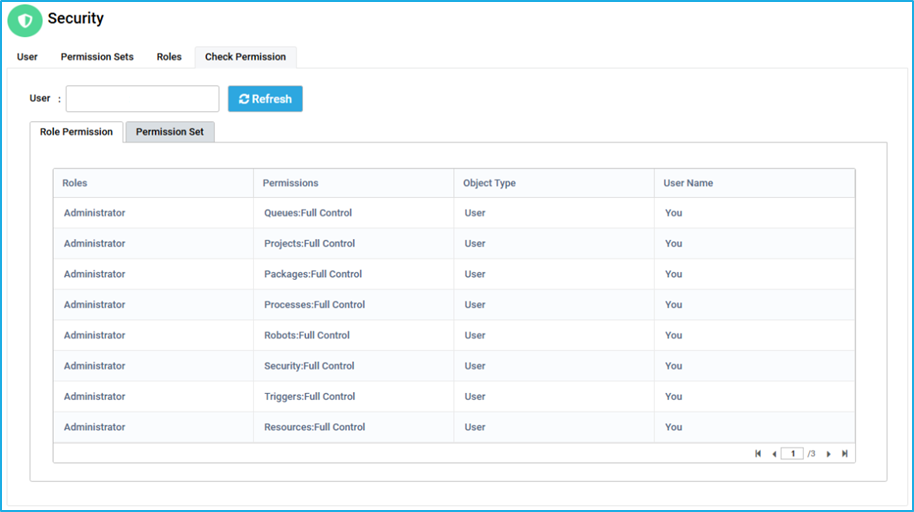
A user without any roles does not have access to any resource. Users can access resources or obtain the necessary authorization to perform specific tasks only when they are assigned with one or more roles.
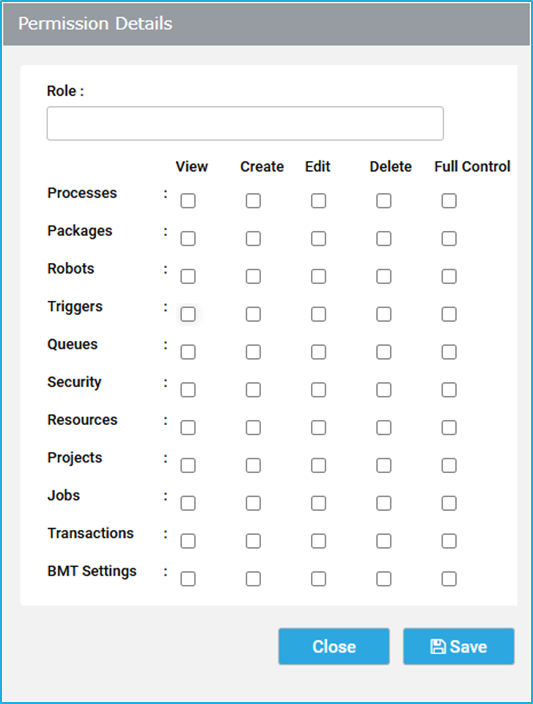
To add roles for a particular user, click on ‘Add Role’ button. A popup ‘Add Role’ will appear where the role name can be entered and permissions (View/Create/Edit/Delete/Full Control) can be selected. Click ‘Save’ to store the changes.
The given permissions can be changed at any time by clicking the ‘Edit’ option. Also, the role can be deleted by clicking ‘Delete’ option.
Note: Projects, Processes, Packages, Robots, triggers, queues, security, resources, jobs, transactions and BMT settings permissions can be restricted by administrators and authorized users by clicking on the edit button for each role.